


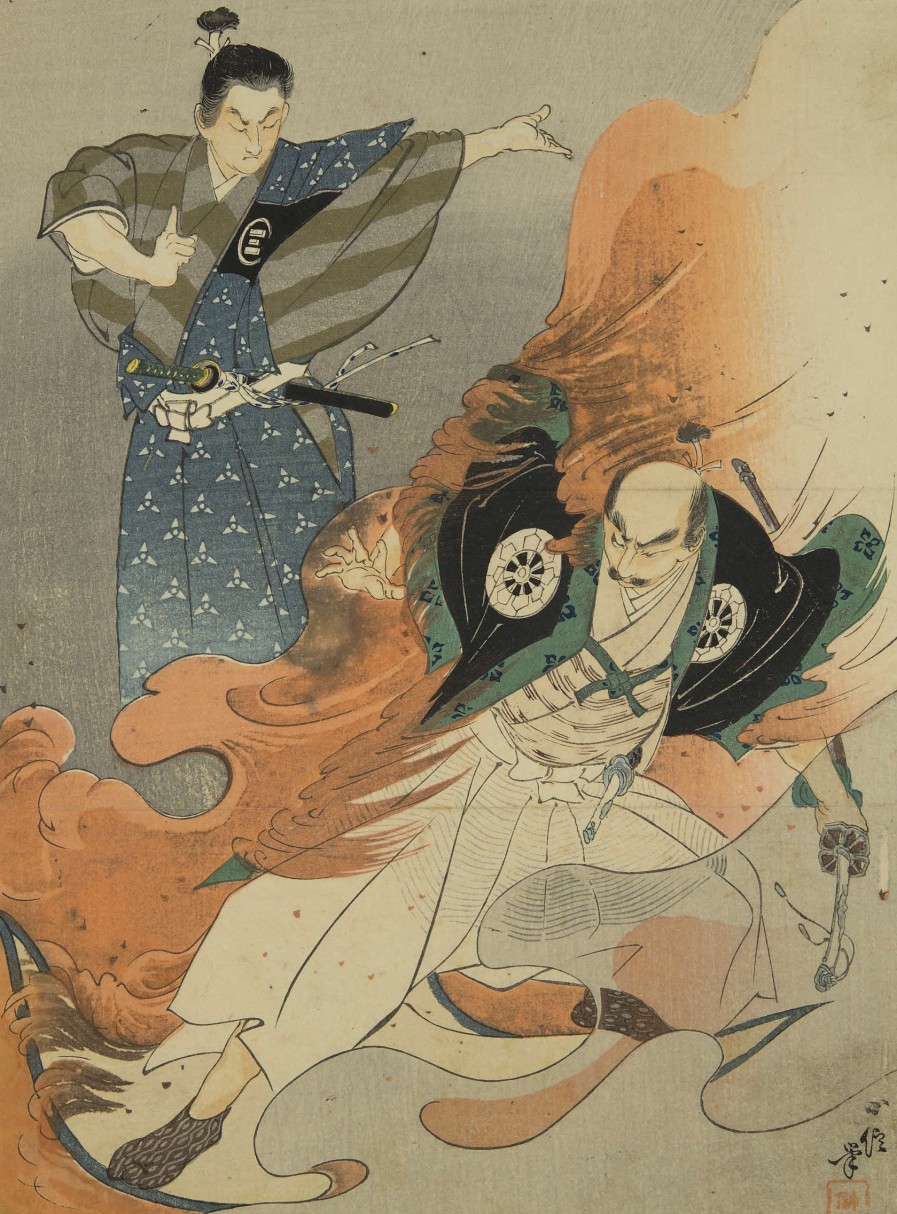
Fire techniques (火術) have been an important option within the repertoire of military strategies (軍略), and like all tactics, they became specialized over time, resulting in increasingly complex formulas for creating fire, explosions, and smoke of different colors and densities, for example.
Within the range of possibilities offered by fire, the use of torches (松明) required liters and liters of ink so that different schools could capture and transmit the secrets of constructing different types of torches. Among so many documents, one is worth a close look, not for its descriptions of torches, but for a short historical introduction to noteworthy events related to fire.
The manuscript Shinobi Taimatsu no Sho (忍松明書) begins by talking about the Three Years' War (奥州後三年合戦), a military chronicle that has Minamoto Yoshiie (源義家) as one of the main protagonists. Despite not naming him or any specific technique using fire, it does give importance to the use of a kite (紙鳶) called shirôshi (鴟老紙). Although the Shinobi Taimatsu no Sho (忍松明書) does not give details about the events, other records do describe the specific event in more detail:
The third volume of Kan Hiroku (關秘錄) states that the kites children fly in spring arose from a war strategy. During the Takehira (武衡) rebellion in Ōshū (奥州), a retainer of Takehira named Okitama Shirō (置賜四郞) infiltrated Yoshiie's (義家) camp as a spy. Surveillance was so strict that he could not communicate with the castle. Then, he remembered an object described in a military manual called a shirōshi (鴟老紙), which is like an octopus. It was a kite with a string attached to it and released by the wind. A message was written on the paper, and a wick was attached so that the string would burn and the paper would fall. Shirō (四郞) remembered this, built a kite, and released it in the direction of the castle when the wind was favorable. For this reason, that night Takehira (武衡) ordered his warriors to attack Hidehira's (秀武) camp, achieving a great victory*.
* 松屋筆記 第2 Books 小山田与清 著 国書刊行会, 明治41
(Also quoting Hiraiwa Chikayoshi (平岩親吉) relating it to the same shirôshi kite (鴟老紙) and the use of torches, implying that this servant general of Tokugawa Ieyasu (徳川家康) made use of the same or similar technique)
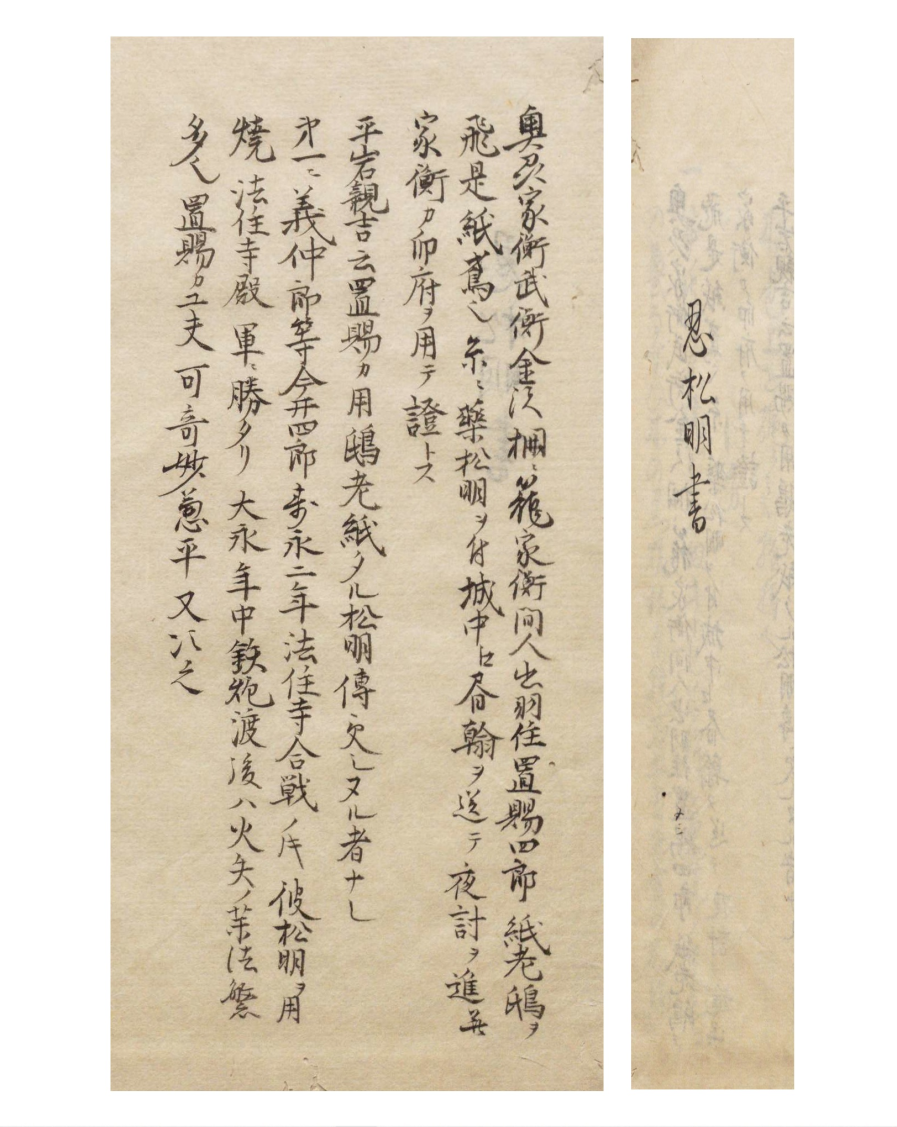
Prologue to the document Shinobi Taimatsu no Sho (忍松明書) recording famous actions using different fire techniques
Regarding the use of a kite combined with fire, the document Kōga Ryū Injutsu Gokui (甲賀流隠術極意) written by the Akutagawa ninja family (芥川氏) of the Matsumoto domain (松本藩), places us in the same war but in its decisive battle in Kanazawa. If before the kite tactic was used against Yoshiie's troops, but now it is a member of his army who uses a kite in a peculiar way.
In ancient times, when Prince Yoshiie attacked Kanazawa Castle, a member of the Hattori school named Hattori Genzō (服部源蔵), who was short in stature, made a large kite (紙凧). During the night, when a strong wind was blowing, Genzō flew the kite and let it rain fire down on Kanazawa Castle, causing it to burn down. This method was kept secret and was said to be like raining fire from the air*.
* 第21回 忍者の火術 三重大学人文学部 教授 山田雄司
The next event presented in the document is the Siege of Hōjūjidono (法住寺合戦) using torches. An event that leads us directly to the famous victory of Kiso Yoshinaka's army against the Taira family army, led by Taira Koremori (平維盛) at The Battle of Kurikara (倶利伽羅) where one night, while the Heike clan army (平家) was sleeping, Yoshinaka's (義仲) forces launched a sudden attack with a great noise. The demoralized Heike army attempted to retreat, but their route was blocked by Higuchi Kanemitsu (樋口兼光), one of Yoshinaka's generals. The Heike army fell into total chaos and tried to escape in the only direction where there was no enemy attack. However, that path led to the cliffs of Kurikara Pass. Unbeknownst to them, the soldiers fell one after another to the bottom of the ravine, resulting in total annihilation.
However, the Genpei Seisuiki (源平盛衰記) offers another version of events, with an interesting but not unique use of fire. Volume 29 contains the chapter titled "Battle on Tonami Mountain" (礪並山合戦), where we read:
It was already midnight on May 11th. As is customary in the May sky, the moonlight shone dimly. On a narrow, dark path beneath the trees of a summer mountain, the Genji and Heike clans could barely be distinguished. The Heike, fearing a night attack, urged their men not to sleep soundly. However, the fatigued warriors used the sleeves of their armor as pillows and their helmets as cushions to rest on. For their part, the Genji had prepared several attack strategies. Among them, Higuchi Jirō Kanemitsu, commanding the rear guard, led more than 3,000 cavalry. One thousand of them carried war drums and conch shells. Kiso gathered 400 or 500 oxen, tied pine torches to their horns, and waited until nightfall to attack.
*参考源平盛衰記
The fact that documents such as the Heike Monogatari (平家物語) and the Gyokuyō (玉葉) do not record this attack using cattle with torches on their horns detracts from, but does not eliminate, the authenticity of the surprise attack by Kiso Yoshinaka's army. Centuries later, Hōjō Sōun (北条早雲) is portrayed using the same technique to seize control of Odawara Castle (小田原城).
One day, Sōun asked permission for his scouts to enter Fujiyori's lands for a deer hunt on Mount Hakone, and Fujiyori granted the request. Sōun disguised his strongest soldiers as scouts and brought them into Mount Hakone. That night, Sōun's soldiers approached Odawara Castle with lit torches on the horns of a thousand oxen. At the same time, the soldiers who had hidden on Mount Hakone disguised as scouts screamed and set fires. Odawara Castle, terrified by what it believed to be an attack by tens of thousands of soldiers, descended into total chaos. It is said that Fujiyori barely escaped with his life, and Sōun easily seized control of Odawara Castle.*
* 北条早雲の群像 川村一彦, 2020
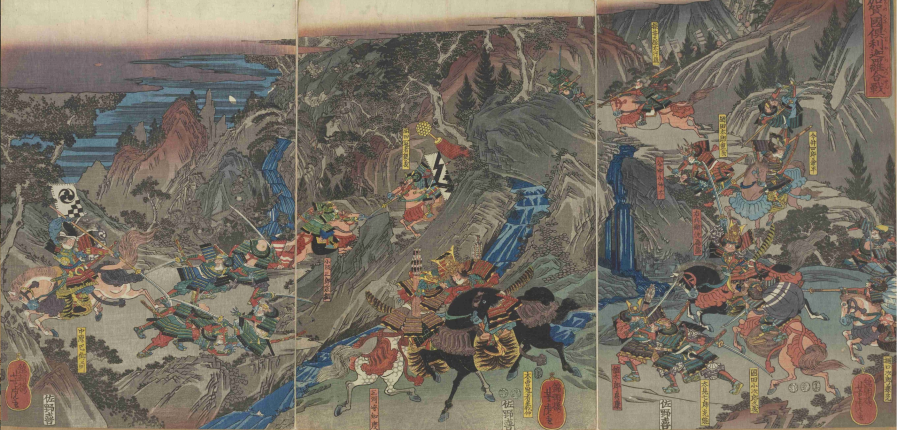
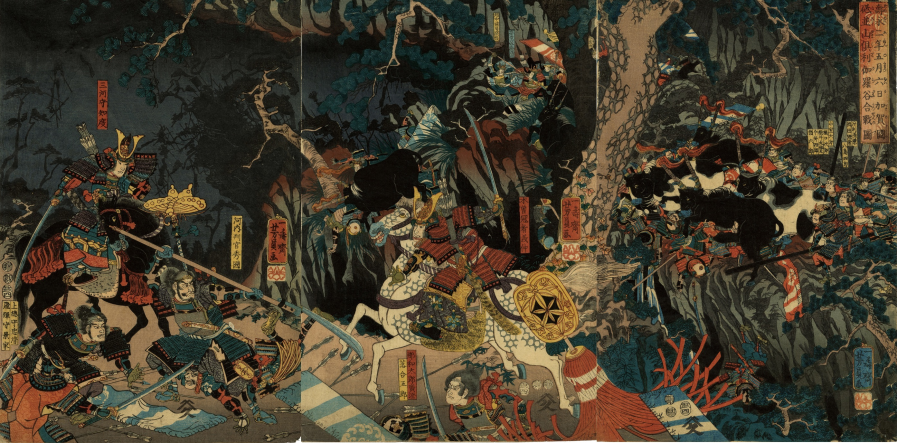
Two versions of the same event: above, the surprise night attack by Yoshinaka's troops, causing chaos and confusion; and below, the attack by Yoshinaka's troops, launching hundreds of oxen with torches on their horns as an advance guard, charging against the Taira army.
Yoshinaka's technique known as the fire oxen tactic (火牛の計) may have been inspired by the strategist Tian Dian (田單, ), a Chinese general during the Warring States Period (戦国時, 475-221 BC) who was noted on the battlefield for pioneering the combination of oxen and torches as a means of attacking enemy troops. The author of the Record of the Grand Historian (史記) described Tian Dan's action as follows:
Tian Dan recogió mil bueyes que había en la ciudad. Los cubrió con sedas de color carmesí, pintándoles dragones de cinco colores, y ató espadas y lanzas a sus cuernos. Después, amarró manojos de cañas impregnadas de grasa a sus colas y les prendió fuego. Abrió decenas de agujeros en la muralla y, por la noche, soltó a los bueyes. Detrás de ellos, los seguían cinco mil guerreros. Las colas de los bueyes, al arder, los encolerizaron, y corrieron directamente hacia el ejército de Yan, que estaba acampado de noche. El resplandor de las antorchas de las colas de los bueyes era deslumbrante. El ejército de Yan los veía como dragones y todo lo que tocaban moría o resultaba herido. Los cinco mil guerreros, que llevaban mordazas en la boca, atacaron a los Yan, mientras que desde la ciudad, los tambores tocaban y los gritos de guerra resonaban. Los ancianos y los niños golpeaban utensilios de bronce, y el estruendo se escuchaba hasta el cielo. El ejército de Yan, aterrorizado, se dispersó y huyó. El pueblo de Qi mató a su general, Qi Jie. El ejército de Yan se desorganizó y huyó, y la gente de Qi los persiguió, avanzando hacia el norte. Las ciudades y pueblos por los que pasaban se rebelaban contra Yan y se unían a Tian Dan. Su ejército crecía cada día. Aprovechando su victoria, Yan iba perdiendo día tras día, hasta que finalmente, llegaron al río. Las más de setenta ciudades de Qi volvieron a pertenecer a Qi. Entonces, recibieron al rey Xiang de vuelta en Ju y lo escoltaron a Linzi para que volviera a gobernar*.
*史記
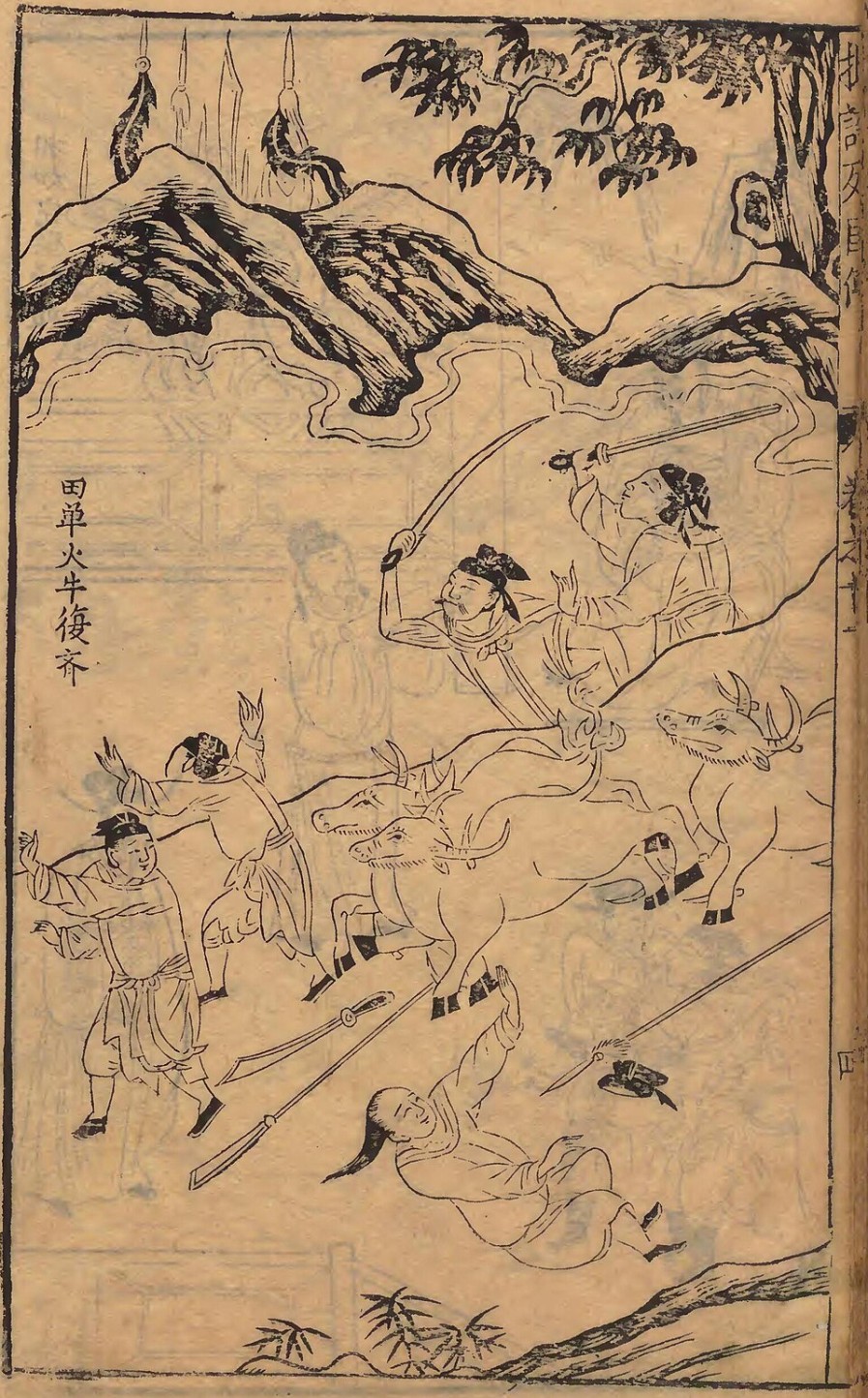
田单火牛复齐 (Tian Dan Fire Oxen for Restoring Qi)
Before traveling to Japan, this fire oxen tactic (火牛の計) continued to wander through China in other conflicts. In the first year of Shaoxing (紹興) (1131) of the Southern Song Dynasty (南宋), the water bandit Shao Qing (邵青) rose up in arms in Xiuzhou (秀州). The imperial court sent Wang De (王德) to suppress the rebellion. Shao Qing attacked using the Tian Dan fire oxen formation. Wang De, upon learning that Shao Qing had gathered oxen, laughed and said, "This is an old tactic, it only works once. Since he doesn't know how to innovate, he will be captured." Wang De stood his ground and shot thousands of arrows. The wounded and terrified oxen turned around, charging into Shao Qing's ranks and trampling countless soldiers. Wang De suppressed the rebellion in a single blow. Also in the first year of Chunyou (淳祐) (1241), Wang Shixian (汪世顯) led a Mongol army (蒙古) to attack Shu (蜀). Commander Chen Longzhi (陳隆之) defended the city of Chengdu (成都), vowing to die for it. General Tian Shixian (田世顯) surrendered, while commander Wang Kui (王夔), defender of Hanzhou (漢州) (present-day Guanghan, Sichuan), used fire oxen to cut a path and escape.
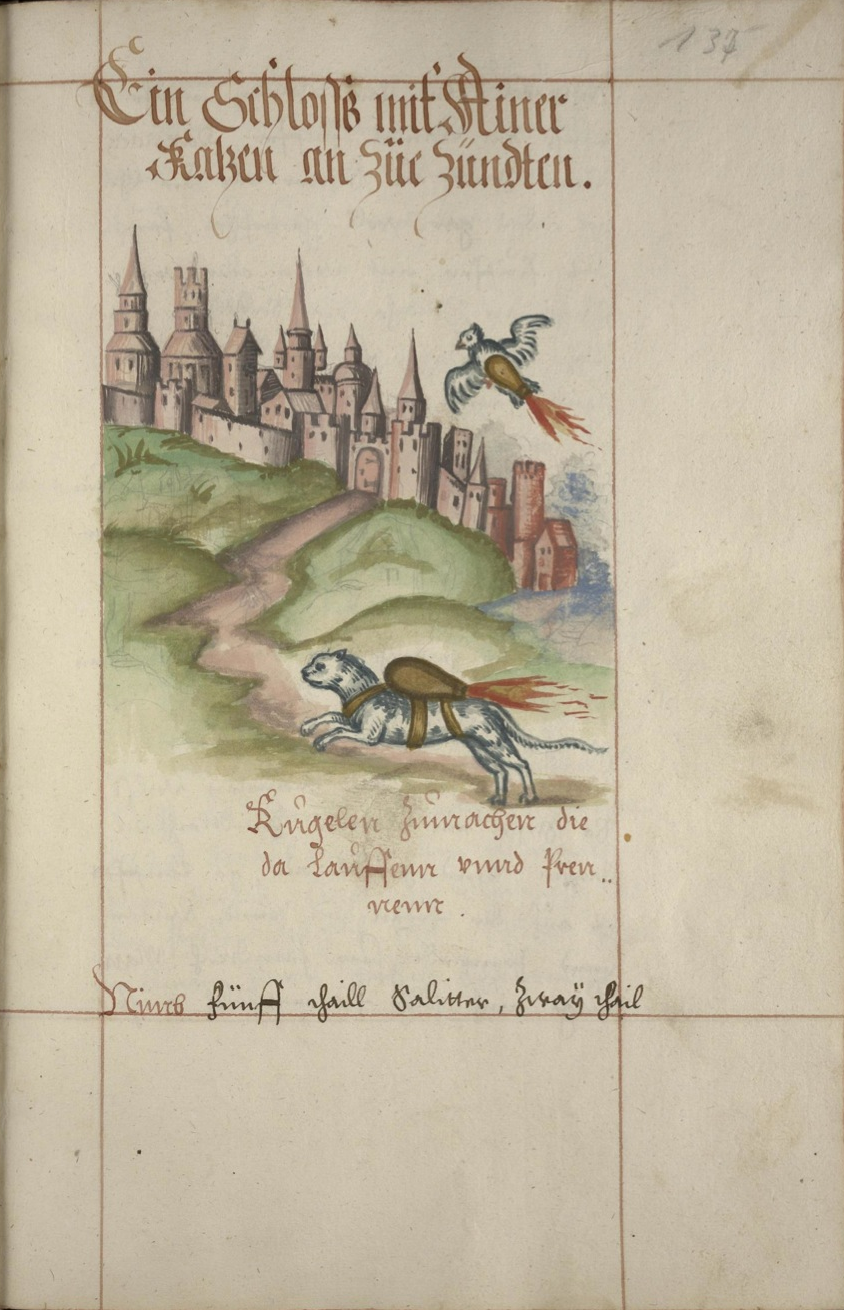
That this fire ox (火牛の計) technique would have traveled from China to Japan would be quite normal, but would it have been able to travel not only to Japan but also to the European continent in the 16th century? An illustrated German manuscript on munitions and explosive devices titled Feuer Buech, created by Franz Helm in 1584, contains, among descriptions of more conventional devices, an image of a cat and a bird carrying incendiary backpacks to attack a besieged city. This image appears on leaf 137. Considering the notorious independence of cats and the very limited carrying capacity of birds in flight, it is extremely doubtful that cats or birds were ever used to set fire to cities or buildings. Most of the other devices in the manuscript seem more practical.
September 29th, 2025, Ensanryū 鳶山龍
Bibliography:
松屋筆記第2, 小山田与清, 国書刊行会, 明治41
忍松明書
参考源平盛衰記
北条早雲の群像, 川村一彦, 2020
史記 (https://ctext.org/shiji/tian-dan-lie-zhuan/zh?searchu=%E7%89%9B%E5%B0%BE&searchmode=showall)
https://www.historyofinformation.com/detail.php?id=4062