


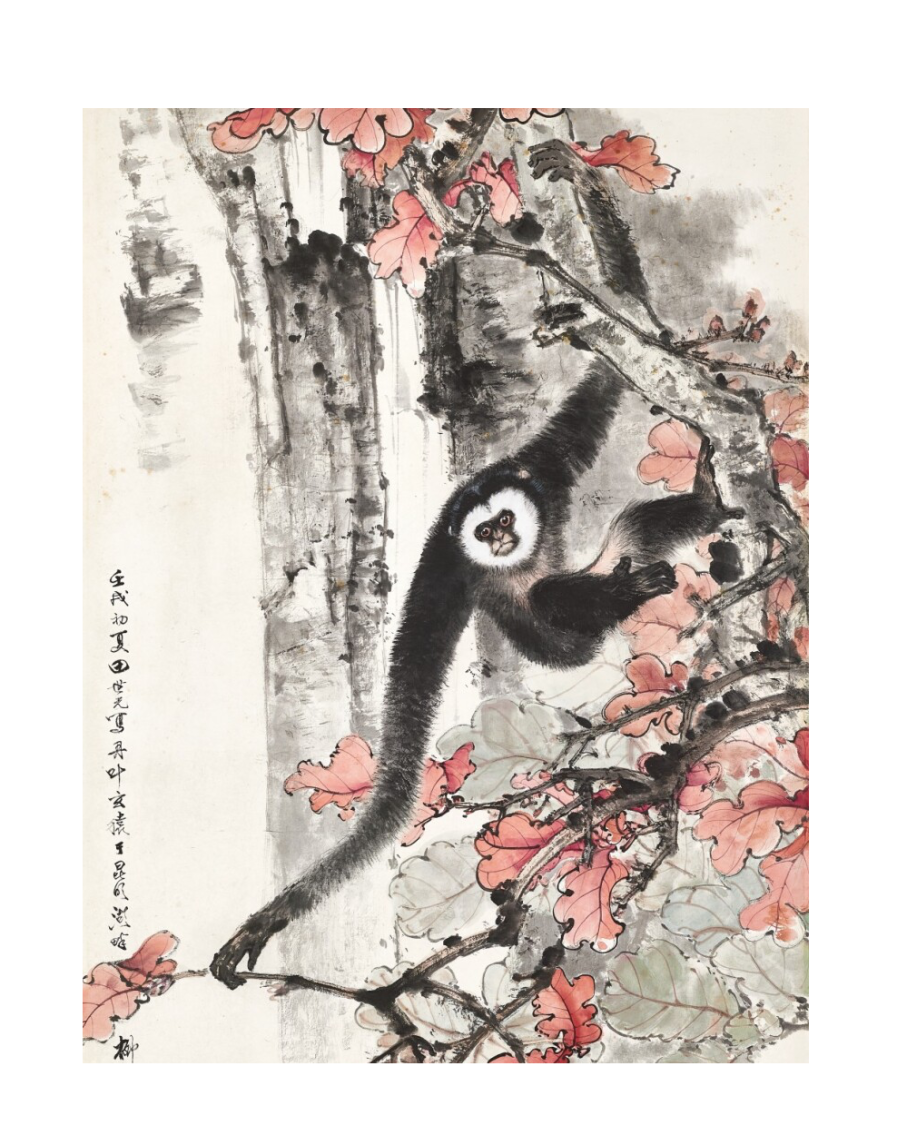
Yue Nü (越女) was possibly the first Chinese female swordsman, whose appearance is found in the collection of stories and anecdotes titled Wu Yue Chunqiu (吳越春秋) during the Spring and Autumn and Warring States Period (春秋戦国時代). Although she does not appear in what are called historical texts, it is well worth reviewing and summarizing her legend and mythology.
During the reign of Goujian of Yue (句践越, 496-465 BC), the King of Yue (越王) was planning to attack the state of Wu (吳国), and his minister Fan Li (范蠡) told him about a maiden living in the forests of southern Yue whose skills were famous among the people. When the King heard of her fame with the sword and halberd, he sent an emissary to invite her to court.
On the way to the audience with the King of Yue, a man named Yuan Gong (袁公)*1 challenged the maiden to a duel. However, realizing he could not match the maiden's skills, Yuan Gong transformed himself into a white monkey (白猿)*2 and fled. It is also said that to test her abilities, Fan Li (范蠡) sent several competent warriors, but they were all defeated.
Upon arriving at the palace, she was questioned by the King of Yue about how she acquired such skill with the sword; the girl said that living in a remote area, there was no opportunity for training; her mastery emerged from nowhere.
The King of Yue insisted on knowing how to acquire mastery, and the girl said it was a subtle and easy path, yet very profound and mysterious. It contains both the right path and wrong practices. It also contains the aspects of yin and yang. The body should be full of energy yet display a calm posture. You can appear like a delicate lady but fight like a fearsome tiger. Adapt to the conditions and be one with the spirit, with free movement in all directions. This form allows one to defeat a hundred, and a hundred to defeat ten thousand.
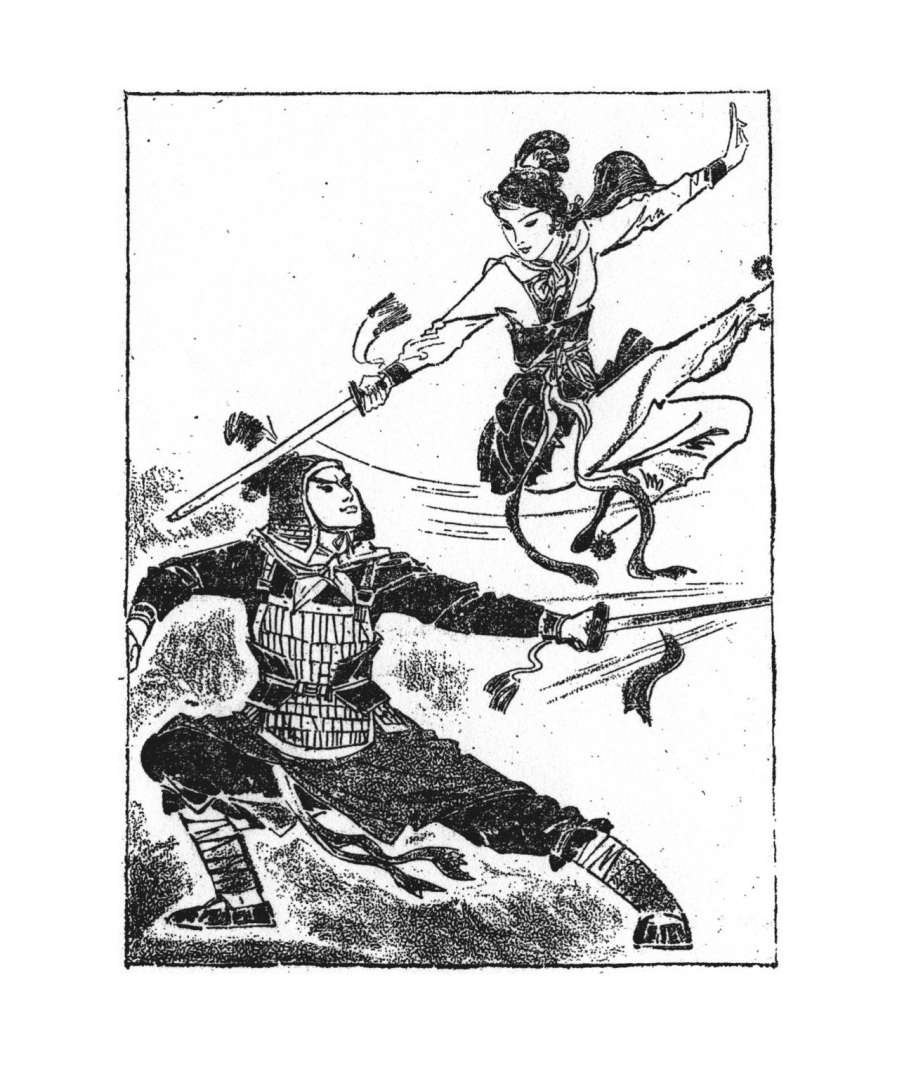
Yue Nü training one of Yue's soldiers in swordsmanship. According to Xiao Jun, Wu Yue Chunqiu Shihua
King Yue, amazed by the story, granted her the name "Maiden of Yue" (越女) and ordered his senior officers and best soldiers to receive training in "the sword method of the Maiden of Yue" (越女剣法).
Going back several centuries, from legend to mythology, transforming the earthly into the heavenly, we exchange the martial arts of Yue Nü (越女) for the warrior and esoteric arts of Xuan Nü (玄女), of whom Yue Nü (越女) is said to have been her reincarnation.
The Mysterious Maiden of the Nine Heavens, Jiutian Xuan Nü (九天玄女), is the Taoist goddess of war, sexuality, and longevity in Chinese mythology. who resides in the celestial court of Huang Di, the Yellow Emperor (黃帝), who was trained by her in the arts of war and esotericism.
If we previously saw how Yue Nü (越女) instructed the King of Yue (越王), now we see how Jiutian Xuan Nü (九天玄女) instructed Huang Di (黃帝). The first lines of the Huangdi Wen Xuannü Bingfa (黃帝問玄女兵法) are the presentation of Xuan Nü (玄女) to Huang Di (黃帝):
The Mysterious Maiden of the Nine Heavens (九天玄女) according to the Ehon Suikoden (絵本水滸伝)
Huangdi (黃帝) fought nine battles against Chi You (蚩尤) and was unable to win any of them. Huang Di retreated to the Great Mountain (太山) and remained there for three days and three nights. A dense fog covered the place, and suddenly a bird-headed woman (人首鳥形) appeared. Huangdi prostrated himself twice and did not dare to stand up. The woman said, 'I am Xuan Nü (玄女). What do you wish to ask?' Huang Di replied, 'I wish to know the method to always win in battle and remain undetected. Where should I begin?'
Thus the Mysterious Maiden instructed Huangdi in methods of divination (六壬, 遁甲)*3, maps and strategies (圖策), seals and swords (印劍), etc., with which he was able to defeat Chi You (蚩尤).
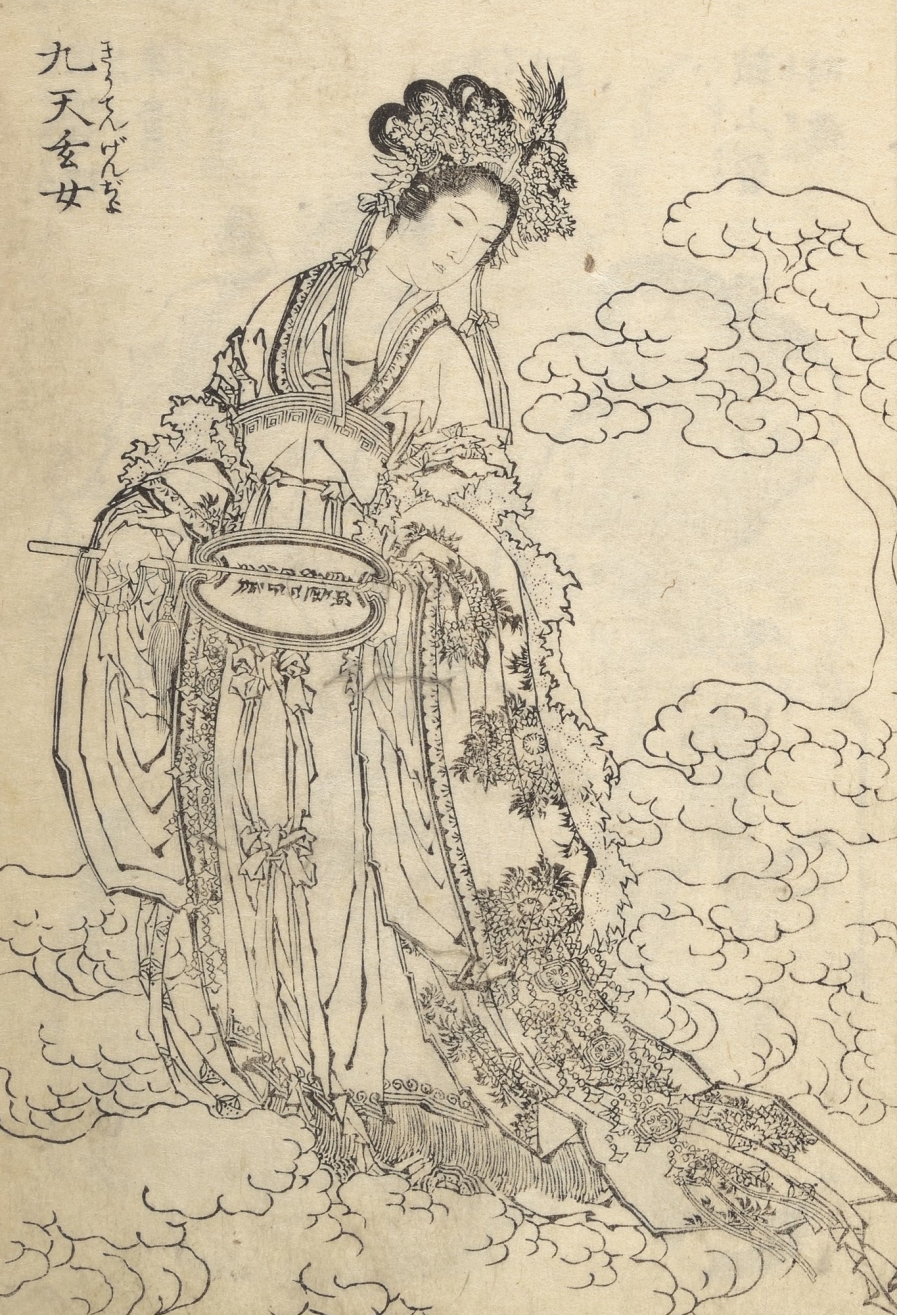
The Mysterious Maiden of the Nine Heavens (九天玄女) according to the Ehon Suikoden (絵本水滸伝)
If previously we talked about Yuan Gong (袁公) transforming into a white monkey (白猿) to flee after challenging Yuen Nu, now Yuan Gong is the personification of the White Monkey God (白猿神) who was condemned to be the guardian of the White Cloud Cave (白雲洞君)*4 for having written on the walls of the cave the secret content of a document he stole from Jiutian Xuan Nü (九天玄女). Among the secrets he wrote were the Method of Shape Change (換形法), the Method to Confuse the Army with White Horses (白馬迷軍之法), the Method of Prohibiting People (禁人法) and the Method of Concealment (隠身法).
Considering that in the chapter questions and answers about ninjutsu of the Bansenshūkai (万川集海 忍術問答) Fuxi (伏羲) and Huang Di (黃帝) are mentioned as the beginning of ninjutsu and military tactics, it is interesting to observe how Huang Di gives importance not only to victory but also to concealment (隠身).
The “original text” of the aforementioned Huangdi Wen Xuannü Bingfa (Huang Di’s Questions to Xuan Nü’s Military Strategies, 黃帝問玄女兵法) says:
萬戰萬勝,萬隱萬匿,
10,000 battles (萬戰) 10,000 victories (萬勝) and 10,000 concealments (萬隱), 10,000 hiding places (萬匿)*5
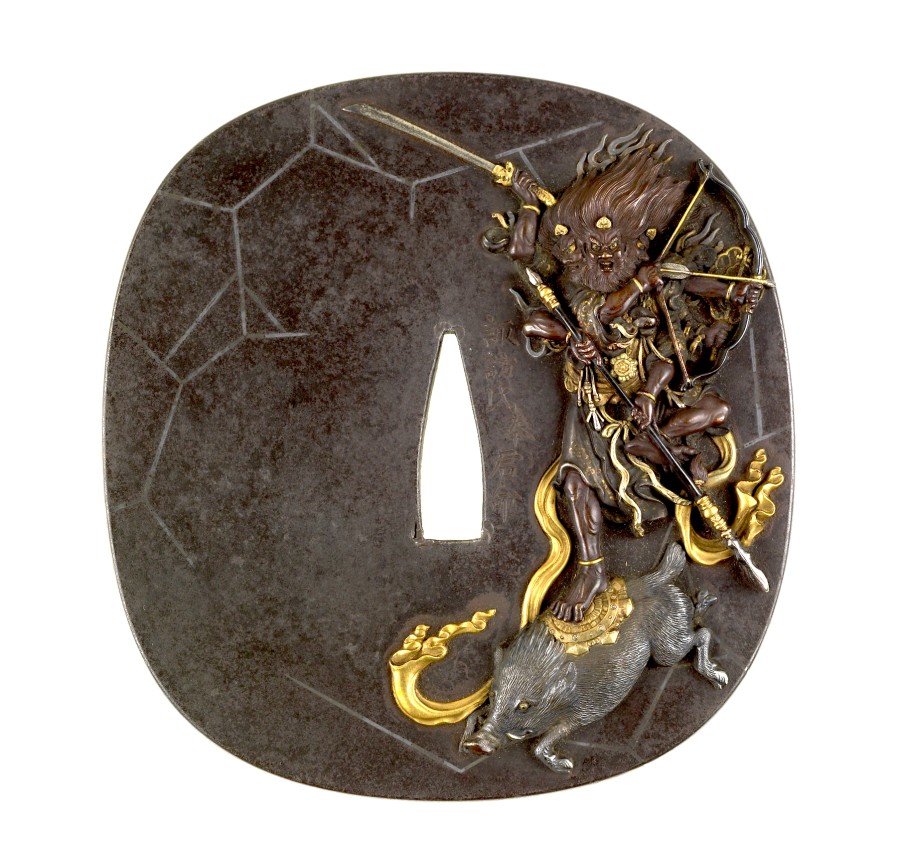
Tsuba (鍔) with engraving of Marishiten (摩利支天) a deity capable of granting invisibility (隠身)
April 3rd, 2025, Ensanryū 鳶山龍
*1 - The origin of the Tongbeiquan (通背拳) fighting style dates back to the story of the fighter Yuan Gong, who, after losing a challenge, transformed into a white monkey (白猿) and fled; this is why the style is sometimes also known as Baiyuan Tongbeiquan (白猿 通背拳).
*2 - A play on words, since Yuan (袁) for name is pronounced the same as Yuan (猿) for monkey.
*3 - Tonkō (遁甲) is not only related to divining good and bad fortune (or directions), but also a method of concealment typical of ninjutsu. Parallel to the legend of the Yellow Emperor in China, in Japan we find Emperor Jinmu (神武天皇) being described as "very skilled in concealment through Tonkō," making the Emperor the first shinobi.
*4 - The White Cloud Cave (白雲洞) appears continuously in stories related to Taoism. Zhang Liang (張良) also secluded himself in the White Cloud Immortal Cave (白雲仙洞) to practice Taoism. A cave that also seems to be related to Huang Shigong (黄石公), the Taoist immortal (道士仙人) who gave Zhang Liang the Six Secret Teachings and Three Strategies (六韜三略) documents.
*5 - Previously translated as “always win and remain undetected”
Bibliography:
- Spring and Autumn Annals of Wu and Yue, author Jianjun He, year 2021
- Speaking to History: The Story of King Goujian in Twentieth-Century China, author Paul Cohen, year 2008
- 中国文學研究 第二十四期 九天玄女考
- 逆説の日本史 2 古代怨霊編: 聖徳太子の称号の謎, author 井沢元彦
- http://www.chinaknowledge.de/Literature/Diverse/huangdiwenxuannvbingfa.html
- https://ctext.org (靈寶六丁秘法)